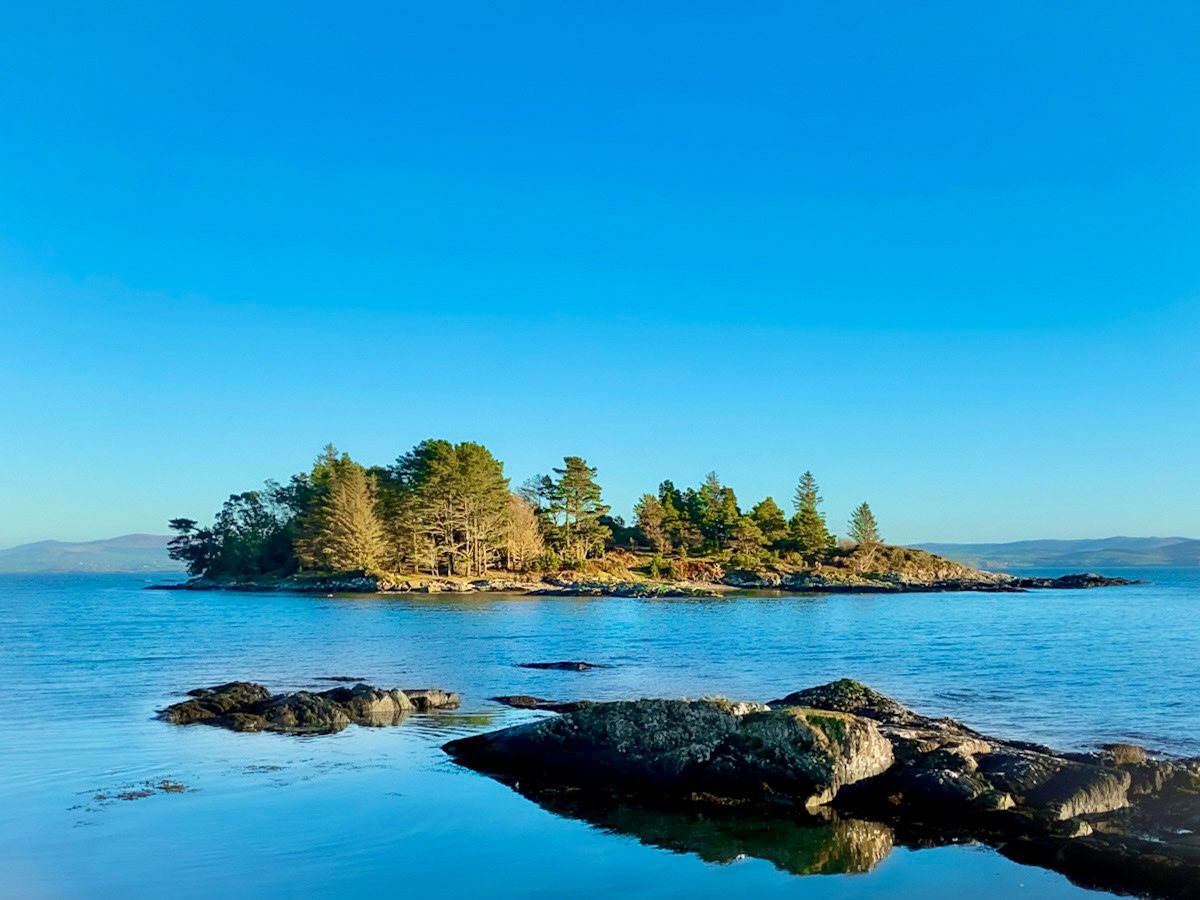
Week 8 (starting 1 December 2025). The less known garinish in Glengarriff Harbour, a famous English astronomer and his mysterious illness
Garinish West, just off Zetland Pier on Beara Peninsula, is an island very close to shore ('Gar Inish' means 'near island' in Irish). Unlike the more well known Garinish in Glengarriff Harbour, Garinish West has been unpopulated except for a small holiday home built by Bernard Lovell in 1966, the famous English astronomer known as the “father of radio astronomy”. In the late 1950s, Lowell led the development of the world-famous telescope at Jodrell Bank in Cheshire, England. As it was being developed, crippling debts mounted and the project looked doomed; at one point Lowell was threatened with imprisonment! But when Russia launched the world’s first satellite and Jodrell Bank was able to track it, funding for the completion of the telescope was secured. Lovell wanted to keep things simple on Garinish West. His wife, Mary, described the island as their "heavenly retreat" and the couple and their children holidayed there often. Its isolation and clear unpolluted skies also allowed Lovell to gaze up at the celestial constellations and contemplate the mysteries of the cosmos. In post-humously released notes, Lovell claimed that, on a trip to a Soviet space facility in the Crimea, he was the victim of an attempted poisoning after he declined to work on the Soviet space programme. He said “it was as though all life had suddenly turned to dust and ashes." Fortunately, the illness lifted during a holiday to Garinish West when he "suddenly began to feel normal”. The true cause of his illness remains unknown.
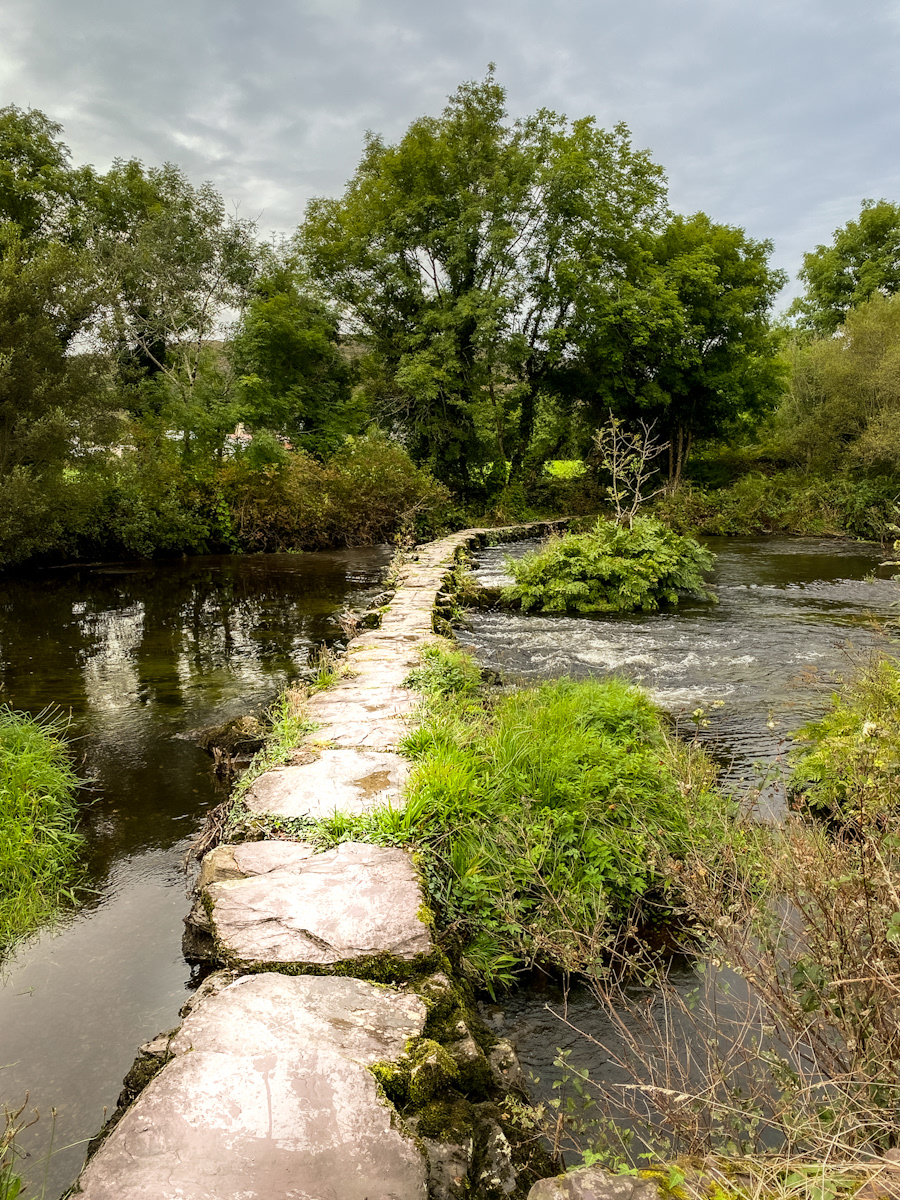
Week 7 starting 24 November 2025: A simple curved “clapper” bridge passing through Ballingeary in West Cork
This bridge, the “Ballingeary Stepping Stones”, crosses the River Lee as it runs eastward across Co Cork before passing through Cork City to meet the Celtic Sea. The bridge, said to be the longest “clapper” (stepping stones) bridges in Ireland, may date to the 17th century and is still used by locals and visitors. The bridge consists of eighteen large flat limestone slabs resting on rubble piers. A relatively unique feature is the bridge’s curve which follows the river’s path to cross it at its shallowest point; greatly reducing the number of stones needed and simplifying its construction. Rather than forcing a straight line against the river, the curved structure offers less resistance to the river’s water flow and means the bridge is less likely to be washed away during any of the many periods of high water and flood. The bridge is part of the Slí Gaeltacht Mhúscrai, a grand walking track which journeys through the heart of the Irish-speaking Gaeltacht region and some of the most scenic landscape in Co Cork. And amongst this walking track’s splendours, this photograph of a simple bridge that crosses the River Lee at its narrowest and shallowest point as it passes through the small village of Ballingeary.
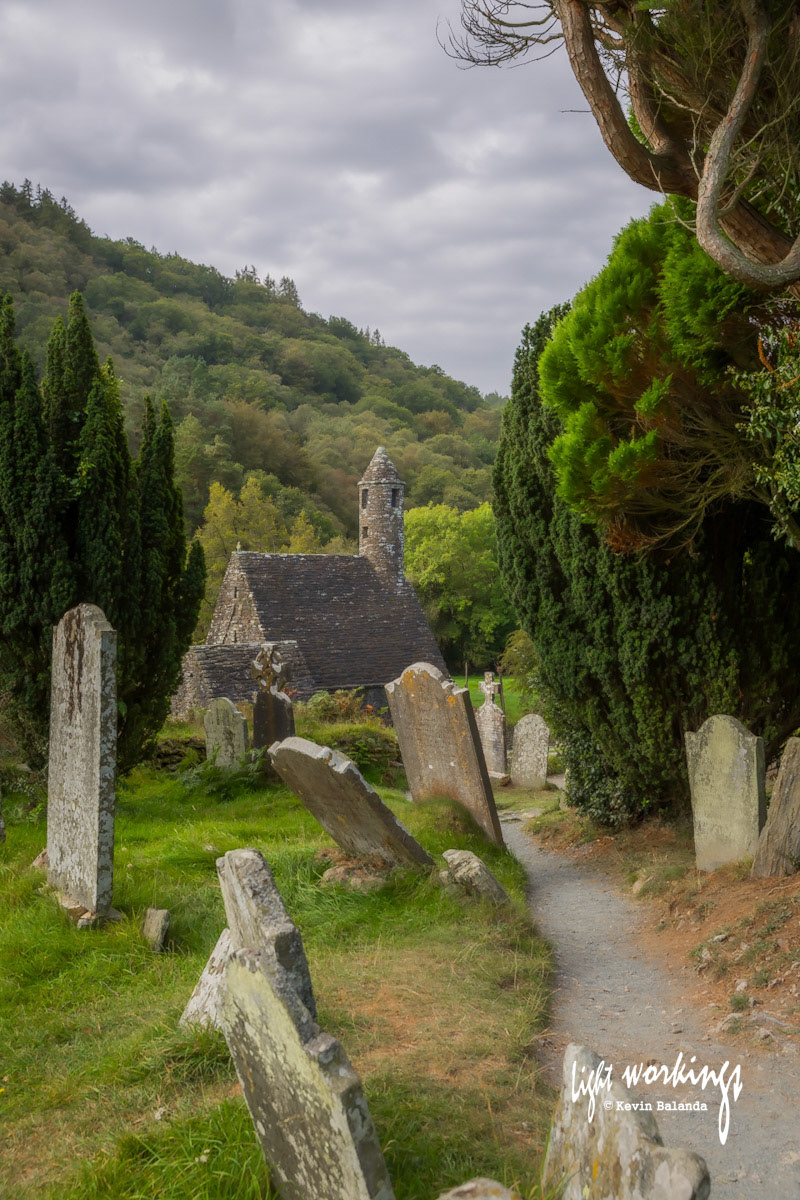
Week 6 starting 17 November 2025: St Kevin’s Kitchen in an ancient settlement at Glendalough in Co Wicklow
This photo of St. Kevin’s Chapel looks across an ancient graveyard at the monastic settlement of Glendalough (meaning “valley of two lakes”) in County Wicklow. The chapel is commonly known as “St. Kevin’s Kitchen” as the bell tower resembles a kitchen chimney and it was mistakenly believed that food was cooked there. The settlement offers a sense of seclusion and an opportunity for reflection amidst the beautiful glacial valley in which it was built. A medieval monastic settlement was founded in the 6th century by St Kevin (or Cóemgen). He led a simple life of prayer here and his fame as a holy man quickly spread across Europe. After his death in 618 AD the settlement flourished for over six centuries and became one of the most famous ecclesiastical centres in Europe. Although the destruction of the settlement by English forces in 1398 left it in ruins, it continues to this day as a place of pilgrimage. The buildings which survived probably date from between the 10th and 12th centuries and include a superb round tower, numerous medieval stone churches (St Kevin’s Chapel being the best preserved) and some decorated crosses. The present remains in Glendalough tell only a small part of its story. As well as being a religious centre, it was also a centre of learning and community life. In its heyday it included workshops, areas for manuscript writing and copying, guest houses, an infirmary, farm buildings and dwellings for both the monks and a large lay population.
Thank you!
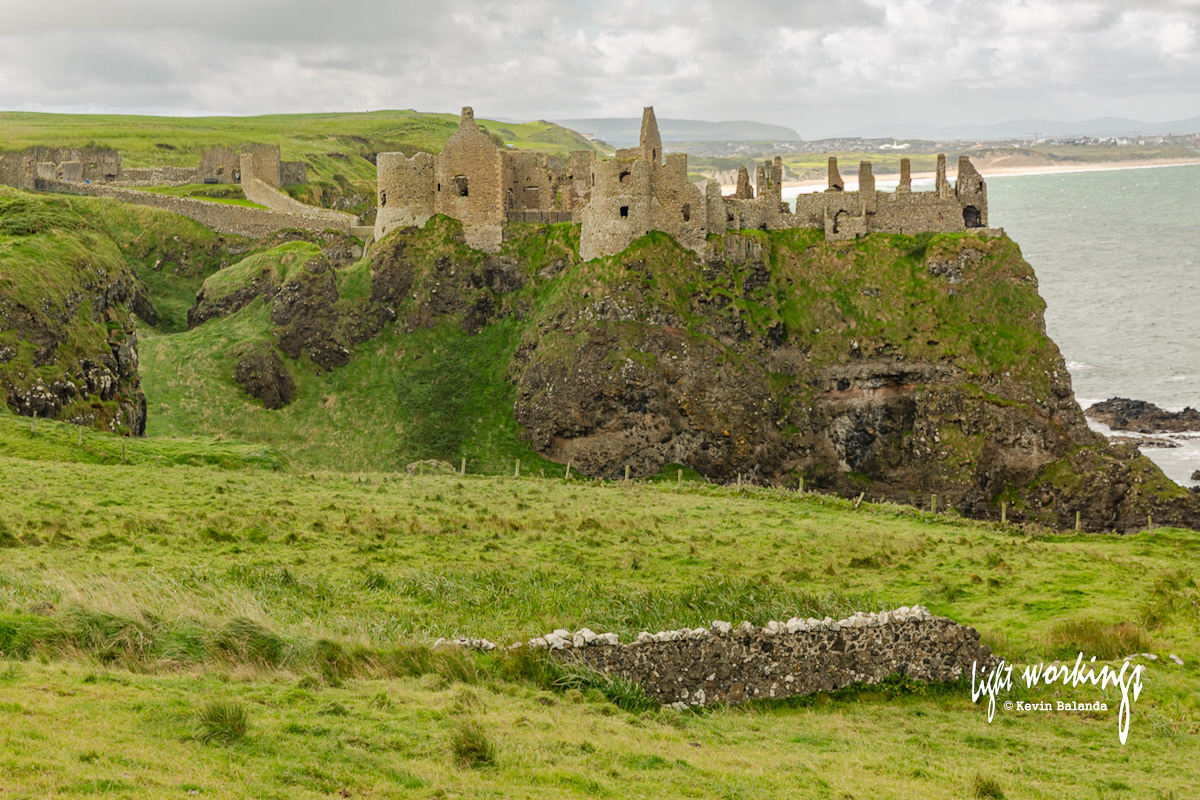
Week 5 starting 10 November 2025: A medieval castle, a violent feud, a tragic love story and a haunted banshee
Dunluce Castle is located at the end of the White Rocks cliffs on the Causeway Coast in Co Antrim. It has witnessed a violent feud between the McQuillans and MacDonnells that is intertwined with the tortured history of Ireland, Scotland and England. History places the castle in the hands of the McQuillans, in 1513, after they became Lords of the Route. They were driven out in 1584 by the MacDonnells, a branch of the Scottish MacDonald clan, after losing two bitter battles in the 1550s and 1580s. Salvage from the wreck of the Girona, part of a failed Spanish invasion of England, was used to restore the castle in 1588. Dunluce Castle was abandoned by the MacDonnells in 1690 after their impoverishment following the Battle of the Boyne. With such powerful histories come many tragic stories. Perhaps the most famous is the story of Maeve Roe, daughter of Lord McQuillan, who refused to marry her father’s chosen husband. As punishment, Maeve was locked into one of the castle’s towers until she mended her ways. She was in love with another man and, on one stormy night, her beloved launched a daring rescue but the pair were drowned in the wild seas below the castle. It is said she can still be seen keeping watch in the tower; her cries can be heard on stormy nights. The castle has a large place in our cultural history. In particular, in 1973 the castle appeared on iithe inner gatefold of the Led Zeppelin album Houses of the Holy.
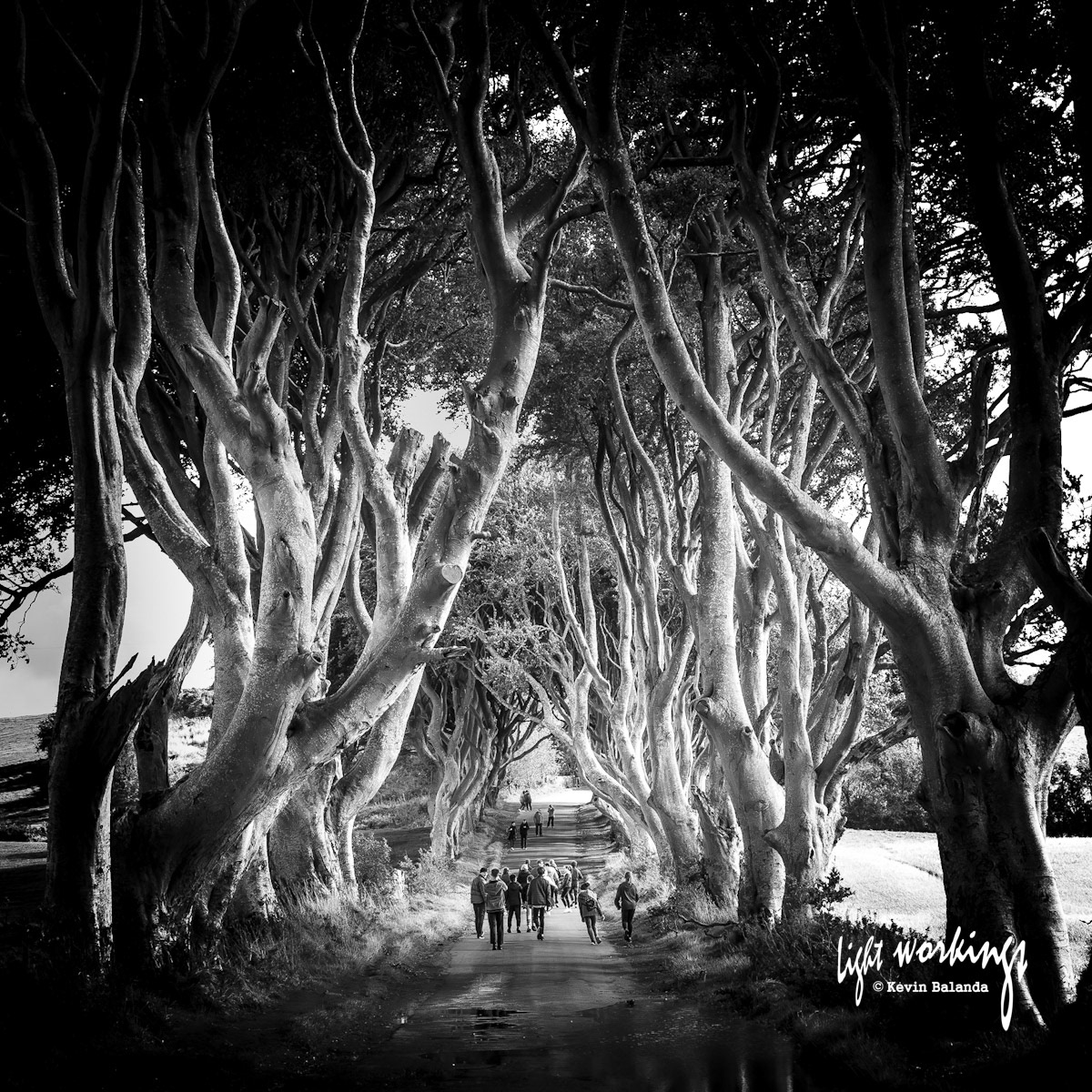
Week 4 starting 3 November 2025: Skipping down The Dark Hedges in Co Antrim where spectres wander
This is a photo of a beautiful avenue of ancient beech trees in Co Antrim, Northen Ireland. With it’s somewhat dark history, a black-and-white photograph seemed appropriate. The trees were planted by James Stuart around 1775 to create an imposing, and thus intimidating, approach to his family’s Georgian mansion, Gracehill House. Legend has it that the hedges are visited by a ghost called the “Grey Lady”; claimed to be either the spirit of James Stuart's daughter or one of the house's maids who died mysteriously centuries ago. Others believe she is a lost spirit from an abandoned nearby graveyard. Given this history, it is not surprising that the avenue features as the King’s Road in HBO's epic series “Game of Thrones. In the series, it is the major route connecting the major cities (Kings Landing in the south and The Wall in the north) in Westeros. Along with other filming locations in Co Antrim; it has become a major tourist attraction amongst “Games of Thrones” fans. Lesser known is that, although the trees still magnificent, many are at risk in heavy storms. Of the 150 trees originally planted, about 90 remained in 2016. As visitor numbers have increased, there have been concerns about vehicular traffic damaging the trees' roots as well as problems of graffiti. As their condition deteriorate, some trees have posed a danger to the public and have had to be felled. Like many beautiful spots in our world, tourism brings its own challenges to The Dark Hedges
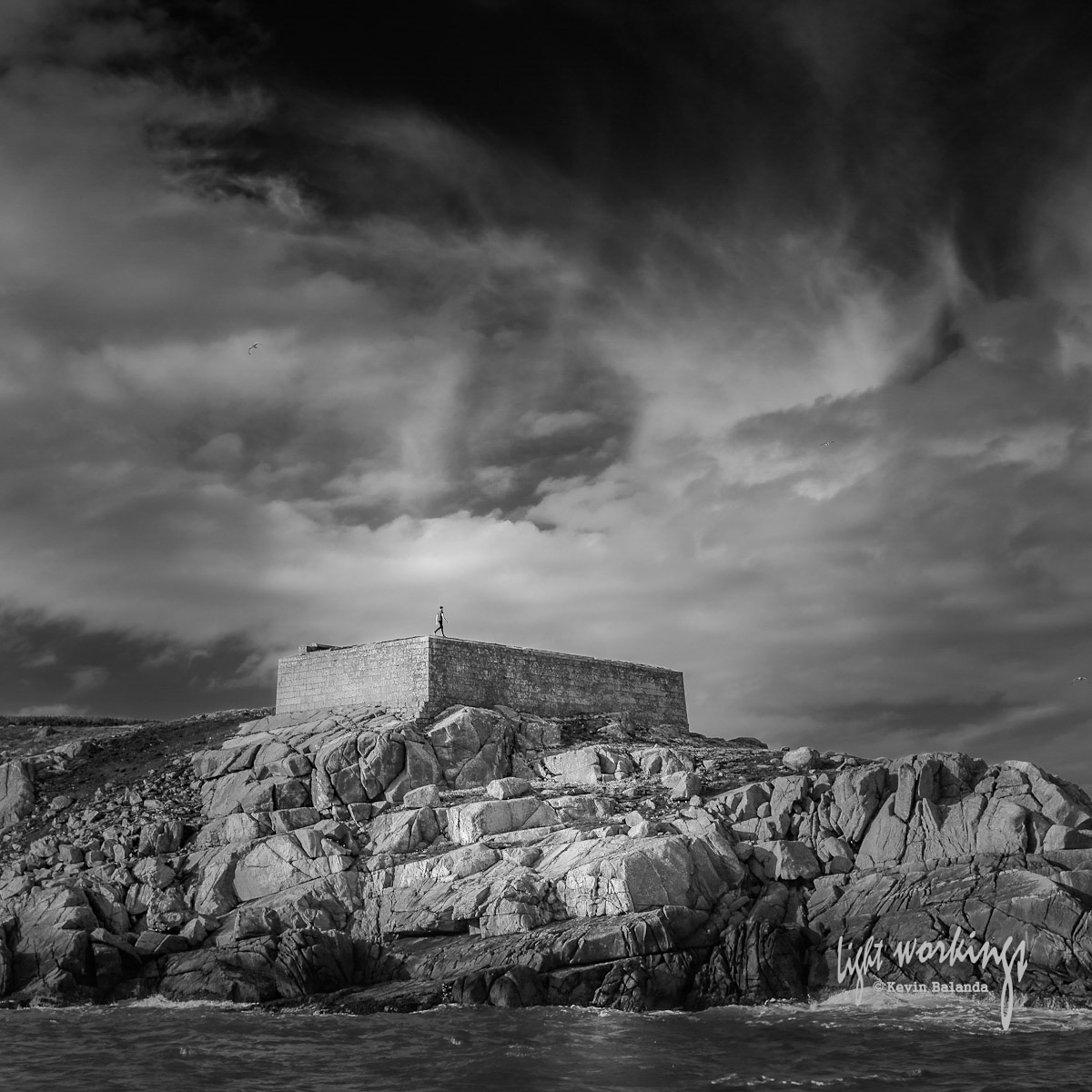
Week 3 starting 27 October 2025: Dalkey Island and defending Ireland against feared and real threats
Dalkey, one of the wealthiest districts in South Dublin, was founded by the Vikings and nearby Collimore Harbour was a busy trading port. Close by, Dalkey Island is separated from the mainland by a narrow but deep channel called Dalkey Sound where ships could safely anchor, sheltered by the island, and unload their heavy cargo. The shallower Dublin Bay prevented direct shipments into Dublin City at the time. This photo tshows the gun battery on Dalkey Island. The gun battery and Martello Tower no. 9, constructed around 1805, were part of defence system built along the coast of Ireland to defend against a feared French invasion during the Napoleonic Wars. However, the French never returned after their failed attempted onvasions in the 1790s along the West coast of Ireland (see Part 1 photo). Eventually, Dalkey Island was abandoned by the military in 1886. A more real threat faced by Europe throughout its history was the bubonic plague. In fact; Colimore Harbour was one of the ports through which the devastating “Black Death” arrived on the east coast of Ireland in the summer of 1348. During one of its return to Ireland in the Middle Ages (in 1575 this time), tradition has it that the wealthier Dublin citizens used Dalkey Island as a place of refuge from this “Great Plague”. While this occasion was mentioned in Samuel Lewis’s 1837 “Topographical Dictionary of Ireland”; Dalkey Island probably played a similar role in earlier outbreaks of the plague. The desperate poor were left to take their chances on the mainland.
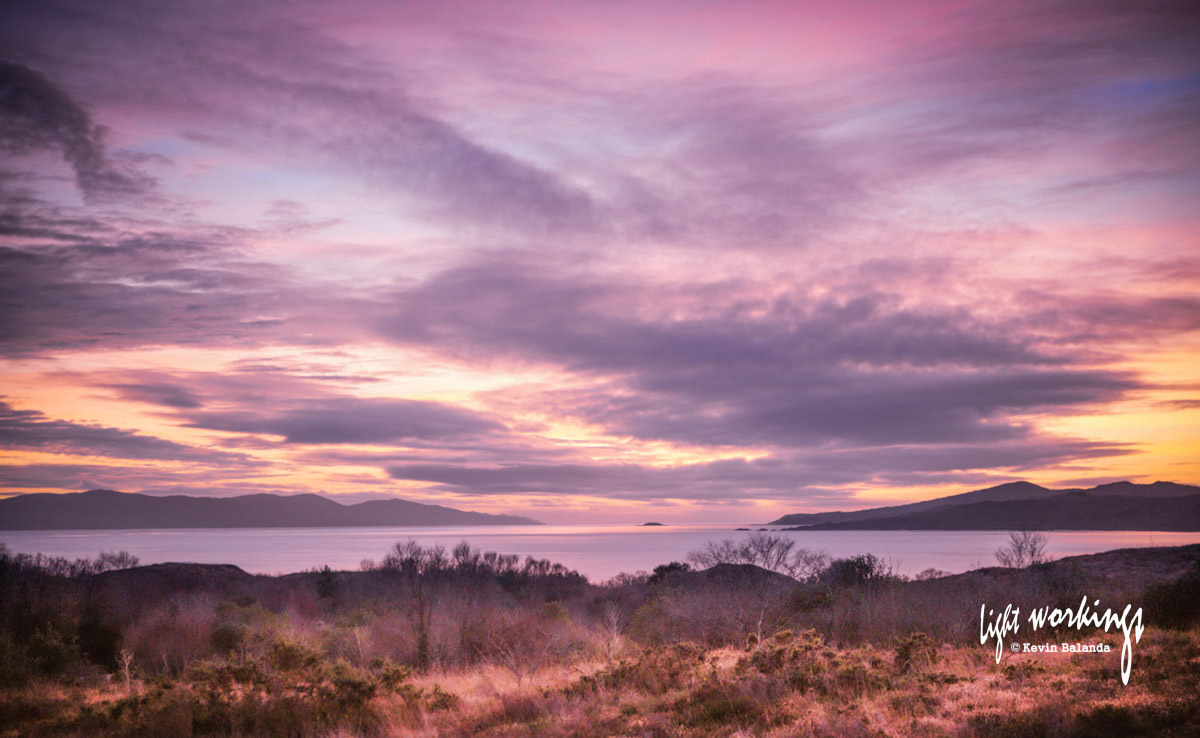
Week 2 starting 20 October 2025: Why the sunsets in West Cork, at the edge of Europe, are so inspiring
This photo was taken on a Winter’s evening looking over Bantry Bay out to the Atlantic Ocean. The Bay is framed by Sheep‘s Head Peninsula on the left and Beara Peninsula on the right. The conditions were perfect. During Winter the sun falls directly between the two peninsulas. On this evening the water was still; providing surfaces that reflected the sky's vibrant colors. The broken clouds in the sky dispersed the light and bounced it onto the shimmering water Later in the evening, halos form around the rugged mountains which eventually became silhouettes under a deeply coloured sky. West Cork in Ireland is blessed with a vast number of spectacular peninsulas, bays and smaller coves. North of Beara Peninsula are Iveragh and Dingle Peninsulas; to the south of Sheep’s Head Peninsula is Mizen Peninsula. Because of their location in the south-west of the island, the sun seems to move along the coastline. Facing the wild Atlantic Ocean; weather conditions are constantly changing and guarantee that no two sunsets are ever the same. From an aesthetic perspective, then, it seems that the West Cork coastline replicates many of the conditions needed for such uniquely beautiful and magical sunset experiences. For the meteorologically minded, moisture and fine dust particles in the lower atmosphere produce these violet displays.
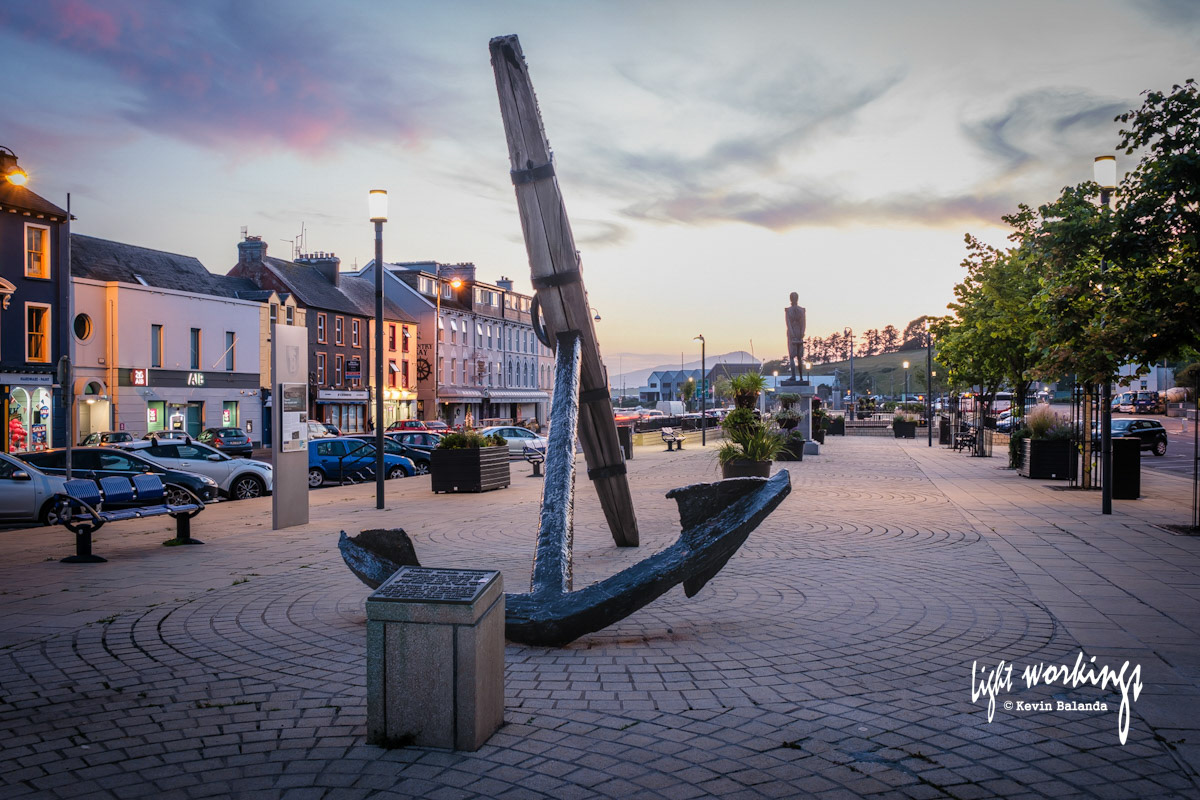
Week 1 starting 13 October 2025: A French warship, an Irish patriot and a town in West Cork
This anchor rests in Wolfe Tone Square in Bantry, West Cork and was salvaged from the French frigate “La Surveillante” which sunk in Bantry Bay. She was part of a failed French invasion of Ireland in December 1796. A year earlier the Irish patriot, Theobald Wolfe Tone, had joined the French Court to form an alliance with France against the English reign in Ireland. Eventually, in December 1796, a French fleet consisting of over forty ships and around 15,000 troops set sail for Ireland. Its goal was to rendevous with Irish rebels at Bantry and spark a rebellion against British rule in Ireland. However; the fleet faced wild storms and seas and, although some ships reached Bantry Bay, the battered fleet received orders to return to France after a few days. In 1798 the French tried again and landed an expeditionary force on the west coast of Ireland but this also ended in failure. Many consider Wolfe Tone to be the founder of Irish Republican Nationalism and this square named after him contains his statue facing out to Bantry Bay. The failed French invasions were key milestones in the Irish fight for independence.